
Physics - Vertical (y) Motion Continues
OPENING QUESTION:
You toss/shoot/kick/launch an object upwards with velocity initial = vi. Sketch that situation and derive and equation to determine how high that object will go.
Now derive an equation for how long it takes to get to hmax
LEARNING OBJECTIVES:
- I will continue to analyze vertical motion problems during today's class.
CALENDAR:
- 1 Dim Motion Test On Thursday, 10/31 (BOO!).
- Motion Lab Redux Due on Friday November 1st.
WORDS O' THE DAY:
- gravity! gravity! gravity!
FORMULAE OBJECTUS:
-
a = (vf - vi)/(tf - ti) (definition of acceleration)
- g = 9.81 m/s2 (acceleration an object experience on Earth) ONLY present in vertical motion (Y axis) problems
horizontal motion:
1) vavg (vf + vi )/2
2) vf = vi +at
3) xf = xi + vit + 1/2at2
4) vf2 - vi2 = 2a∆x
vertical motion:
1) vavg = (vf + vi )/2
2) vf = vi + ag t
3) yf = yi + vit + 1/2ag t2
4) vf2 - vi2 = 2a∆y
WORK O' THE DAY:
Now let's jump into the wonderful world of vertical motion problems:
The graphic below has a LOT of information in it. Take a few moments to review/analyze that graphic with your team and write down observations, interesting tidbits, curiosities, questions and/or other items that come to mind.
Please be prepared to share your findings:
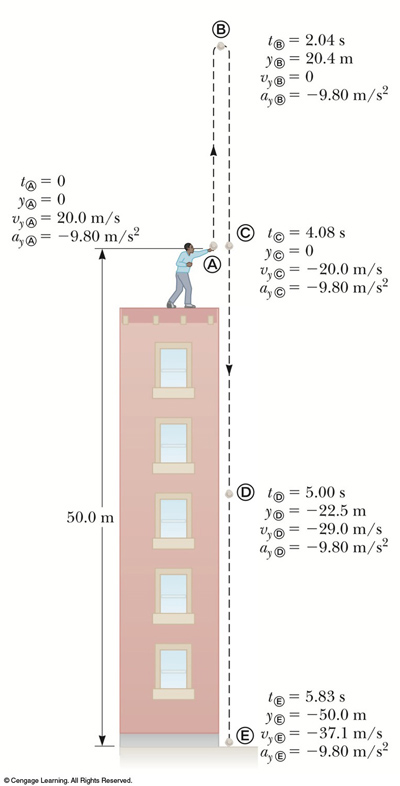 |
There are a couple of things to keep in mind when we evaluate motion in 1 dim (vertically):
Here's a pretty complex graphic. Look at JUST parts A and B. What can you determine from the values shown there? |
Let's change directions and take a look at a couple of practice problems in our book: #40, 42 and 43.
There's a lot going on in the following problem from the Physics Classroom: (let's discuss)
Julietta and Jackson are playing miniature golf. Julietta's ball rolls into a long. straight upward incline with a speed of 2.95 m/s and accelerates at -0.876 m/s/s for 1.54 seconds until it reaches the top of the incline and then continues along an elevated section. Determine the length of the incline.
Now please go and do the tower problem #25. It's fairly mellow.
We'll work the next problem together.
Let's be a bit intentional now-- please write a brief self reflection: What part of 1-dim motion problems give you the most indigestion. Why?
What parts are you most confident with? Why?
Please turn that into me when you're done.